
Relationships often reveal parts of us that we didn’t know were there. A small misunderstanding can suddenly escalate into anger, withdrawal, or deep anxiety. A partner’s silence might feel like rejection, and a critical comment can spark defensiveness that seems disproportionate to the moment.
Afterwards, many people feel confused or ashamed. Why did I react like that? Why couldn’t I stay calm?
But these reactions are rarely random. Beneath them lies a powerful biological system that’s working constantly to protect us: the nervous system. When we begin to understand how this system operates, particularly in the context of past experience and attachment, our responses in relationships start to make much more sense (Porges, 2011; Van der Kolk, 2014).
Rather than being an obstacle to connection, the nervous system is often actually trying to preserve it.
The Body Is Always Listening for Safety
Human beings are biologically wired to detect safety or threat in their surroundings. Long before the thinking mind has evaluated a situation, the nervous system is already scanning for cues in tone of voice, facial expression, posture, and distance.
If the body senses safety, it allows us to remain open, curious, and socially engaged. If it detects a potential threat, it prepares us to protect ourselves.
This process happens automatically and extremely quickly. It is governed by the autonomic nervous system, which regulates states of calm engagement, mobilisation (fight or flight), or shutdown. As described in the work of polyvagal theory, these shifts occur through unconscious neural processes designed to ensure survival (Porges, 2011).
In relational situations, the nervous system often responds not just to what is happening now, but to what the moment resembles from the past (Levine, 2010; Van der Kolk, 2014).
The reaction may seem excessive in the present moment, but to the nervous system, it can feel like a familiar signal of danger.
The Invisible Triggers Beneath Reactions
Many emotional reactions in relationships are driven by processes that operate below conscious awareness. The body stores patterns of response that were learned in earlier environments, especially during periods of vulnerability or stress (Van der Kolk, 2014).
When a current situation echoes those earlier experiences, the nervous system may activate protective responses automatically. These reactions often appear as anger, anxiety, defensiveness, withdrawal, or emotional overwhelm.
In trauma-informed perspectives, these responses are not viewed as signs of weakness or dysfunction, they are understood as adaptive strategies the body developed in order to cope (Levine, 2010).
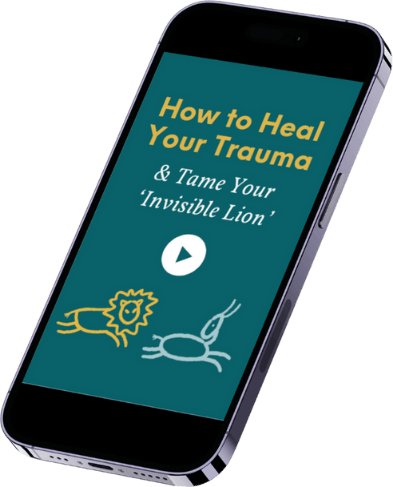
Trauma is like an Invisible Lion. The nervous system reacts as though a threat is present, even when the conscious mind knows that the situation is not life-threatening. The body is responding to a perceived danger signal, not necessarily to the objective reality of the moment (Fry, 2019).
When people recognise that their reactions are rooted in protective biology rather than personal failure, the experience can become less confusing and more compassionate.
Attachment Shapes How the Nervous System Interprets Connection
Attachment theory provides another important piece of the puzzle. Early relationships with caregivers play a central role in shaping how the nervous system interprets closeness, distance, and emotional communication.
When caregivers are reliably responsive and attuned, the developing nervous system learns that connection is generally safe. Emotional distress can be soothed through the presence of another person, and the body learns how to return to balance (Schore, 2003).
When early relationships are inconsistent, unpredictable, or frightening, the nervous system may develop heightened sensitivity to relational cues. A small change in tone or attention may be interpreted as a signal that connection is at risk (Bowlby, 1969).
These patterns do not remain confined to childhood. They often continue to influence adult relationships, shaping expectations about closeness, rejection, and safety.
This is why certain relational situations can feel so emotionally intense. The nervous system may be responding not only to the present interaction but also to earlier experiences that formed its template for connection.
The Power of Co-Regulation
Although many people assume emotional regulation is purely an individual skill, nervous systems are deeply relational. Humans regulate one another constantly through subtle signals of safety and reassurance (Porges, 2011).
This process is known as co-regulation.
A calm tone of voice, gentle eye contact, steady pacing of conversation, and genuine responsiveness all communicate safety to another nervous system. These cues can help reduce stress responses and bring the body back toward balance.
In infancy, co-regulation is essential. A distressed baby relies entirely on a caregiver’s presence to return to calm. Over time, the nervous system gradually internalises these regulatory experiences (Schore, 2003).
Yet this need does not disappear in adulthood. Supportive relationships continue to play a powerful role in stabilising the nervous system.
When conflict occurs in relationships, the ability to return to connection, to repair, reassure, and acknowledge emotional impact, helps restore safety. Repeated experiences of this kind allow the nervous system to update its expectations and gradually become less reactive to perceived threat (Porges, 2011).
Boundaries as a Form of Safety
Healthy relationships are not built on constant closeness alone. They also require clear boundaries.
Boundaries are often misunderstood as walls that separate people, but in reality, they create the conditions that allow connection to remain safe and nourishing. When we feel able to express limits, needs, and preferences, there is greater stability and clarity, which reduces the uncertainty that can otherwise trigger stress responses.
Seen from this perspective, boundaries are not acts of rejection. They are acts of regulation. They help maintain the emotional space in which authentic connection can exist.
Moving from Self-Criticism to Curiosity
One of the most transformative shifts people can make is moving from self-judgement to curiosity.
When a strong emotional reaction appears, the immediate impulse is often to criticise ourselves or the other person. But a more helpful question might be: What signal of danger did my nervous system just detect?
This question opens the door to exploration rather than blame. It recognises that the body may be responding to something meaningful, even if the reaction seems disproportionate. By approaching these moments with curiosity, people often discover patterns rooted in earlier experiences of stress, loss, or relational uncertainty (Van der Kolk, 2014).
Awareness alone does not instantly dissolve these patterns. But it creates space for new responses to emerge.
Relearning Safety in Relationship
Healing relational reactivity is not about suppressing emotions or forcing calmness. Instead, it involves gradually helping the nervous system relearn what safety feels like.
This process often unfolds through repeated experiences of connection where conflict can occur without leading to abandonment, criticism, or emotional shutdown. Repair, empathy, and responsiveness become crucial.
Over time, the nervous system begins to update its predictions about relationships (Porges, 2011; Schore, 2003). Situations that once triggered intense alarm may begin to feel less threatening. The body learns that not every raised voice means rejection, and that not every disagreement means the end of connection.
The Nervous System as an Ally
At first glance, the nervous system may appear to be the source of relational problems. Its reactions can feel disruptive, overwhelming, or unpredictable. But when we look more closely, we see something different.
The nervous system is trying, often desperately, to protect connection, dignity, and emotional safety. Its responses are rooted in survival mechanisms that evolved to keep us alive and bonded to others (Porges, 2011).
When we approach these reactions with understanding rather than hostility, a new relationship with our internal experience becomes possible. Instead of fighting the nervous system, we can learn to listen to it. And in doing so, we begin to create the conditions in which both the body and our relationships can gradually move toward greater safety, resilience, and connection.
References
Bowlby, J. (1969). Attachment and Loss: Vol. 1 – Attachment. Basic Books. https://ia800205.us.archive.org/5/items/attachmentlossvo00john/attachmentlossvo00john.pdf
Fry, B. (2019). The Invisible Lion: How to Tame Your Nervous System and Reclaim Your Power. Watkins Publishing. https://benjaminfry.co.uk/the-invisible-lion/
Levine, P. (2010). In an Unspoken Voice: How the Body Releases Trauma and Restores Goodness. North Atlantic Books. https://archive.org/details/inunspokenvoiceh0000levi
Porges, S. W. (2011). The Polyvagal Theory: Neurophysiological Foundations of Emotions, Attachment, Communication, and Self-Regulation. W. W. Norton & Company. https://archive.org/details/polyvagaltheoryn0000porg
Schore, A. N. (2003). Affect Regulation and the Repair of the Self. W. W. Norton & Company. https://www.academia.edu/45262427/Affect_Regulation_and_the_Repair_of_the_Self
Van der Kolk, B. (2014). The Body Keeps the Score: Brain, Mind, and Body in the Healing of Trauma. Viking. https://ia601604.us.archive.org/35/items/the-body-keeps-the-score-pdf/The-Body-Keeps-the-Score-PDF.pdf